To Wong Foo, Thanks For Everything, Julie Newmar

I woke up at 4am this morning full of dread. My colleagues and I had recently conducted a study of homicidal ideation in family carers and it was about to hit the press. I was terrified that dodgy journalists and click-hungry editors would twist the story, shaming carers and making it even harder for them to ask for or receive the support they need. I was worried that the carers who trusted me with their stories would think I’d sold them out and that the advocacy organisations I work with would regret ever having supported the research.

It’s now almost 8pm and I’ve barely been off the phone. I’m exhausted, I’m hungry, I’m pretty sure I smell, and I am completely overwhelmed by the positive response. From the first story in the Sydney Morning Herald, to an interview with The World Today that I did in my dressing gown, every journalist I’ve spoken to has been respectful, cautious, and genuinely concerned about the wellbeing of carers. Even the outlets that are not normally known for their tact have been incredibly compassionate. 2GB’s Chris Smith, for example, sent a fruit basket to one carer who called in, because he felt so helpless in the face of her despair. And the fact that this was the Most Read story on The Age website today is testament to just how important these issues are!

It’s been a privilege to spend my day talking about carers and the amazing work that they do, raising awareness of the dark times, and encouraging a public discussion about how our society thinks about care. I’ve spoken to journalists from Tamworth to Toorak and I want to send a heartfelt thanks to every one of them for helping us raise the profile of carers and being brave enough to have these difficult conversations without resorting to nasty headlines and cheap clickbait. I especially want to thank those who gave carers the opportunity to call in and share their stories on air – it was compelling, heartbreaking, and a thousand times more powerful than anything I said.

But now my mascara is sliding down my face, my throat is sore, and it’s time for bed. Tomorrow I will get up and keep fighting the good fight. Because carers are worth it!
Powerful Ageing

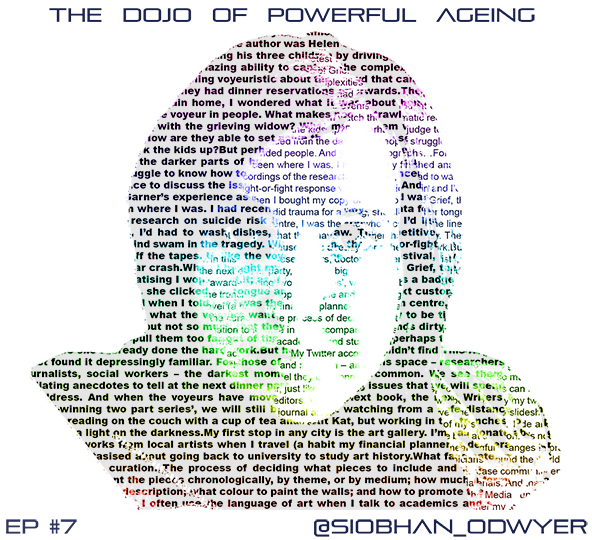
I was recently invited to be a guest on Adam Holcroft’s Dojo of Powerful Ageing Podcast. It was a wide-ranging conversation that covered everything from social media and dementia to hipsters and self-care. It was a real treat to talk to Adam and you can listen to the interview here (Note: It starts at 00:04:45)

Adam also creates a beautiful artwork to go with each podcast and I am completely in love with mine. It’s like Hemingway meets Logan’s Run, with a dash of Warhol, and it really captures who I am and what I do. Thanks Adam!

Screen Shot 2014-10-11 at 11.26.15 PM

The Curated Self

My first stop in any city is the art gallery. I’m passionate about great art, I like to buy works from local artists when I travel (a habit my financial planner is desperate to break!), and I’ve often fantasised about going back to university to study art history.

What fascinates me most about art galleries is the curation. The process of deciding what pieces to include and what pieces to leave out; whether to present the pieces chronologically, by theme, or by medium; how much information to include in the accompanying description; what colour to paint the walls; and how to promote the exhibition.

Curation is, itself, an artform and I often use the language of art when I talk to academics and students about social media and their online presence. Deciding on the what, where, when, how, and why of the information we present to the public is an act of curation.

My Twitter account, for example, is carefully constructed. I work hard to keep 70-90% of my content ‘on message’ – that is, tweets about dementia, carers, suicide, health, ageing, and research – and to ensure that only 10-30% are general interest or personal. I also keep the personal content suitably generic. Enough that people get a sense of who I am and feel they can connect with me as a person, but not so much that they  know which brand of toothpaste I use.

When it comes to my tweets, I’m constantly mindful of the fact that Twitter, just like an art gallery, is a public space. My tweets can and will be seen by current or prospective employers, funding bodies, students, colleagues, industry partners, and journal editors. And, whether I like it or not, I will be judged by my tweets.

This website is also an act of curation. I realised there were parts of my personal exhibition all over the web. A few journal articles here, some media coverage there; a slideshow over on that site, some tweets over on this one. By bringing them together in one place, I had an opportunity to curate my self. I got to decide what parts of my self to include and what parts to leave out, how to group my works, and what colour to paint my walls. And in doing so I was deciding how to promote my self.

Most academics are bad at curation. It’s not something we’re trained to do and we often learn by trial and error. But if we can learn to do it well, we increase the likelihood that our research will lead to meaningful changes in practice and policy. In its first week online, for example, this site had more than 900 views (from people in 30 different countries) and I’ve had requests from clinicians around the world to use my research to support their practice. Carefully curated content can also help to breakdown the negative stereotypes of researchers and scientists and increase community engagement.

So the next time you’re at an art gallery, don’t just look at the art. Look at the walls, the lighting, the descriptions, the sequence and the promotional materials. And then, like all great artists, steal those ideas and apply them to your own work.